
<cat point>
(1).What are points in cats?
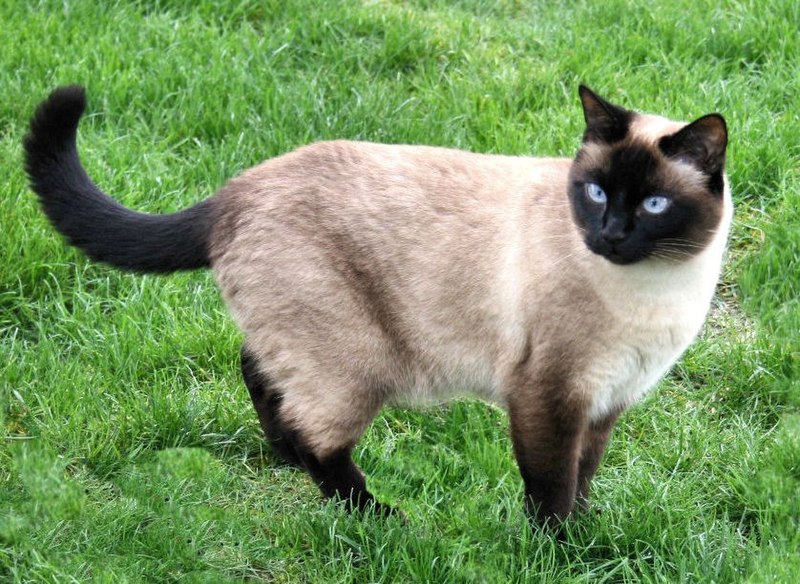
Point coloration in cats originated in the Siamese and closely related Asian breeds, and is found in many Western-developed modern breeds. It is a form of partial albinism resulting from a mutation that affects tyrosinase, an enzyme involved with melanin production. The mutated enzyme is thermolabile; it fails to work at normal body temperatures, but becomes active in cooler areas of the skin.[1] As a result, dark pigment is limited to the coldest areas of the body, that is, the extremities. Pointed kittens are born white, since the womb is uniformly warm. As the kitten ages, the cooler areas darken while warmer areas remain cream to white in color. Points are not limited to solid colors or dark colors. It is possible to have a red (orange color) or fawn (pale warm gray) point. It is also possible to have a tortoiseshell or tabby point. A cat (of any breed) with this coloration is often called a colorpoint cat to distinguish it from others.
(2)How many points do cats have?
As the expression of the gene responsible for the pointed pattern is regulated by temperature, pointed cats who live in cooler environments often show increased darkening of their fur relative to cats who live in warmer climates, sometimes even developing large dark areas along their sides.
Because of the pigment restriction caused by the temperature sensitive tyrosinase, pointed cat’s eyes are always shades of blue because the blue layer in the eye common to all cats is not covered by another color. The back of the eye also lacks pigment, giving colorpoint cats’ pupils an eerie red and silver reflection in the dark, unlike a normally pigmented cat’s shining silver-green or -blue.
(3)What is seal point cat?
The point gene allele is at the C locus, where pure albinism is also carried, and is written as cs. Point is recessive, so two copies of cs, one from each parent, are needed for points to be expressed. Also carried on the C locus is the gene for the sepia pattern. This is the darkest of all of the pigment restricting patterns—pigment is only paled at the warmest point in the body: the abdomen. The sepia allele is represented by cb. When a cat carries the genes cs and cb, the mink pattern is formed, in which the pigment distribution is between sepia and point.
(4)What is a color point kitten?
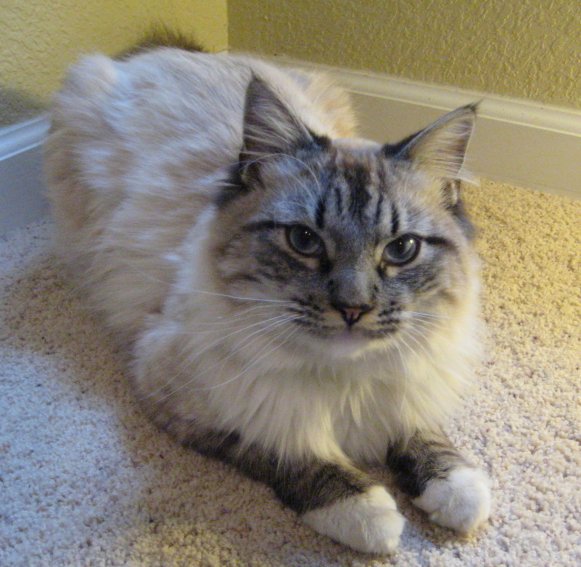
The lynx point pattern is formed by mating a colorpoint cat with a tabby cat (or breeding cats that already possess the lynx point pattern). It is characterized by a mixture of the darkening (reduced) of point coloration with distinct tabby striping on the head, tail, and legs, and an otherwise uniform and comparatively pale body. It is an accepted pattern in some cat registries, but not others, for particular breeds (mostly Siamese-related).[2]
Point coloration is inherent to the Siamese breed and some other closely related breeds but with most other breeds the colorpoints (including lynx) were brought into some breed lines long after their establishment, but there are exceptions. For example, lynx point was a feature of some of the foundation stock of the Siberian.[3]
(5).What are points in cats?
Point coloration in cats originated in the Siamese and closely related Asian breeds, and is found in many Western-developed modern breeds. It is a form of partial albinism resulting from a mutation that affects tyrosinase, an enzyme involved with melanin production. The mutated enzyme is thermolabile; it fails to work at normal body temperatures, but becomes active in cooler areas of the skin.[1] As a result, dark pigment is limited to the coldest areas of the body, that is, the extremities. Pointed kittens are born white, since the womb is uniformly warm. As the kitten ages, the cooler areas darken while warmer areas remain cream to white in color. Points are not limited to solid colors or dark colors. It is possible to have a red (orange color) or fawn (pale warm gray) point. It is also possible to have a tortoiseshell or tabby point. A cat (of any breed) with this coloration is often called a colorpoint cat to distinguish it from others.
(6)How many points do cats have?
As the expression of the gene responsible for the pointed pattern is regulated by temperature, pointed cats who live in cooler environments often show increased darkening of their fur relative to cats who live in warmer climates, sometimes even developing large dark areas along their sides.
Because of the pigment restriction caused by the temperature sensitive tyrosinase, pointed cat’s eyes are always shades of blue because the blue layer in the eye common to all cats is not covered by another color. The back of the eye also lacks pigment, giving colorpoint cats’ pupils an eerie red and silver reflection in the dark, unlike a normally pigmented cat’s shining silver-green or -blue.
(7)What is seal point cat?
The point gene allele is at the C locus, where pure albinism is also carried, and is written as cs. Point is recessive, so two copies of cs, one from each parent, are needed for points to be expressed. Also carried on the C locus is the gene for the sepia pattern. This is the darkest of all of the pigment restricting patterns—pigment is only paled at the warmest point in the body: the abdomen. The sepia allele is represented by cb. When a cat carries the genes cs and cb, the mink pattern is formed, in which the pigment distribution is between sepia and point.
(8)What is a color point kitten?
The lynx point pattern is formed by mating a colorpoint cat with a tabby cat (or breeding cats that already possess the lynx point pattern). It is characterized by a mixture of the darkening (reduced) of point coloration with distinct tabby striping on the head, tail, and legs, and an otherwise uniform and comparatively pale body. It is an accepted pattern in some cat registries, but not others, for particular breeds (mostly Siamese-related).[2]
Point coloration is inherent to the Siamese breed and some other closely related breeds but with most other breeds the colorpoints (including lynx) were brought into some breed lines long after their establishment, but there are exceptions. For example, lynx point was a feature of some of the foundation stock of the Siberian.[3]






Leave A Comment