
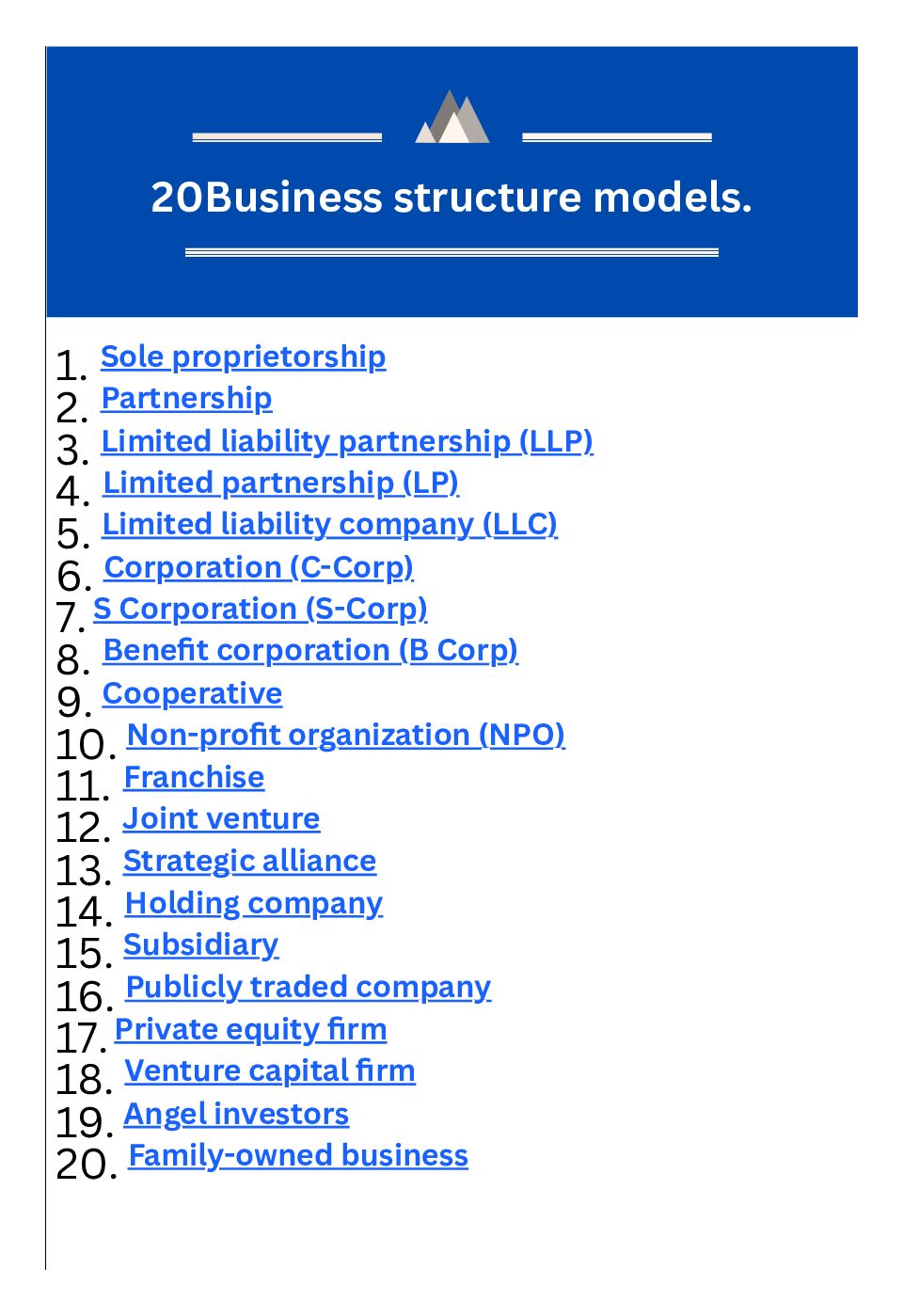

<20 Business Structure Models.(plus how to choose one)>
- Sole proprietorship
- Partnership
- Limited liability partnership (LLP)
- Limited partnership (LP)
- Limited liability company (LLC)
- Corporation (C-Corp)
- S Corporation (S-Corp)
- Benefit corporation (B Corp)
- Cooperative
- Non-profit organization (NPO)
- Franchise
- Joint venture
- Strategic alliance
- Holding company
- Subsidiary
- Publicly traded company
- Private equity firm
- Venture capital firm
- Angel investors
- Family-owned business
here are brief explanations and some key differences between the different types of business structures:
<what are the different types of business structure models>
- Sole proprietorship: A business owned and operated by a single individual. The owner is personally liable for all business debts and obligations.
- Partnership: A business owned by two or more people. The partners share profits, losses, and management responsibilities. Partners are personally liable for the debts and obligations of the business.
- Limited liability partnership (LLP): Similar to a general partnership, but partners have limited liability for the debts and obligations of the business.
- Limited partnership (LP): A partnership in which there are one or more general partners who manage the business and are personally liable for its debts, and one or more limited partners who invest in the business but have limited liability.
- Limited liability company (LLC): A hybrid structure that combines the liability protection of a corporation with the tax benefits of a partnership. Owners (members) have limited liability for business debts and obligations.
- Corporation (C-Corp):https://freshily.co.in/ A separate legal entity that can sue and be sued, and that is owned by shareholders who elect a board of directors to manage the business. Shareholders are not personally liable for the debts and obligations of the business.
- S Corporation (S-Corp): A type of corporation that passes through profits and losses to shareholders for tax purposes, like a partnership. S-Corps are limited to 100 shareholders, who must all be U.S. citizens or residents.
- Benefit corporation (B Corp): A type of corporation that is legally required to consider the impact of its decisions on society and the environment, in addition to its shareholders.
- Cooperative: A business owned and operated by its members, who share in the profits and decision-making. Cooperatives can be organized as corporations or LLCs.
- Non-profit organization (NPO): A type of corporation or association that is organized for purposes other than generating profits, such as for charitable, educational, or religious purposes.
- Franchise: A business model in which a company (the franchisor) grants a license to another person or entity (the franchisee) to operate a business using the franchisor’s trademark, products, and systems.
- Joint venture: A business partnership between two or more parties for a specific project or purpose. Each party contributes resources and shares in the profits and losses.
- Strategic alliance: A cooperative agreement between two or more businesses to work together on a project or objective, without creating a separate legal entity.
- Holding company: A company that owns and manages other companies, but does not engage in any business operations itself.
- Subsidiary: A company that is owned by another company (the parent company), and that operates as a separate legal entity.
- Publicly traded company: A company that has issued shares of stock to the public and is listed on a stock exchange, allowing anyone to buy and sell shares.
- Private equity firm: A company that invests in other companies by purchasing a controlling stake in them, with the goal of improving their performance and profitability.
- Venture capital firm: A company that invests in startups and other high-growth businesses, often in exchange for equity ownership.
- Angel investors: Individuals who invest their own money in startups or other high-growth businesses, often in exchange for equity ownership.
- Family-owned business: A business owned and operated by members of a family. Ownership and management are typically passed down through generations.
- The required documents and process for doing business will vary depending on the type of business structure and the specific laws and regulations in your state or country. Here is a general overview of the documents and steps you may need to take for each of the business structure models you listed:
-
Sole proprietorship: Documents:
- Business license (if required by your state or local government)
- DBA (doing business as) registration (if you plan to use a name other than your own)
Process:
- Register your business with your state or local government (if required)
- Obtain any necessary permits or licenses
- Open a separate bank account for your business
- Obtain any necessary insurance
- Start doing business!
-
Partnership: Documents:
- Partnership agreement (outlining how profits, losses, and management responsibilities will be divided)
- Business license (if required by your state or local government)
- DBA (doing business as) registration (if you plan to use a name other than your own)
Process:
- Choose a business name and check if it’s available
- Register your partnership with your state or local government
- Obtain any necessary permits or licenses
- Open a separate bank account for your business
- Obtain any necessary insurance
- Start doing business!
-
Limited liability partnership (LLP): Documents:
- Partnership agreement (outlining how profits, losses, and management responsibilities will be divided)
- Certificate of formation (filed with your state government)
Process:
- Choose a business name and check if it’s available
- File a certificate of formation with your state government
- Obtain any necessary permits or licenses
- Open a separate bank account for your business
- Obtain any necessary insurance
- Start doing business!
-
Limited partnership (LP): Documents:
- Partnership agreement (outlining how profits, losses, and management responsibilities will be divided)
- Certificate of limited partnership (filed with your state government)
Process:
- Choose a business name and check if it’s available
- File a certificate of limited partnership with your state government
- Obtain any necessary permits or licenses
- Open a separate bank account for your business
- Obtain any necessary insurance
- Start doing business!
-
Limited liability company (LLC): Documents:
- Articles of organization (filed with your state government)
- Operating agreement (outlining how profits, losses, and management responsibilities will be divided)
Process:
- Choose a business name and check if it’s available
- File articles of organization with your state government
- Obtain any necessary permits or licenses
- Open a separate bank account for your business
- Obtain any necessary insurance
- Start doing business!
-
Corporation (C-Corp): Documents:
- Articles of incorporation (filed with your state government)
- Bylaws (outlining how the corporation will be managed)
Process:
- Choose a business name and check if it’s available
- File articles of incorporation with your state government
- Obtain any necessary permits or licenses
- Open a separate bank account for your business
- Obtain any necessary insurance
- Start doing business!
-
S Corporation (S-Corp): Documents:
- Articles of incorporation (filed with your state government)
- Election to be treated as an S-Corp for tax purposes
Process:
- Choose a business name and check if it’s available
- File articles of incorporation with your state government
- Obtain any necessary permits or licenses
- Open a separate bank account for your business
- Obtain any necessary insurance
- File an election to be treated as an S-Corp for tax purposes with the IRS
- Start doing business!
-
Benefit corporation (B Corp): Documents:
- Articles of incorporation (filed with your state government)
- Benefit corporation status designation




Leave A Comment